Tree Removal in Lubbock, TX
Most trees that come down in Lubbock were planted forty or fifty years ago for fast shade, have lived on lawn sprinklers ever since, and have spent every spring in some of the strongest sustained wind of any American city.
When a tree actually needs to come down
Plenty of trees that look bad can be kept, and some that look fine should not be. The useful question is not "is it ugly" but "what fails next, and what does it land on". A local tree company working the job properly will walk round the tree, look at the base and the main forks, and give you a view on both.
- More than about half the crown dead or leafless in summer, with no sign of recovery after a wet spell
- A trunk crack, a split running down from a fork, or bark falling away in sheets
- Mushrooms or soft, crumbly wood at the base, which usually means root or butt rot
- A lean that has changed recently, especially with soil heaved up on the opposite side
- A tree that has already dropped a large limb and has more like it over the house
- Roots lifting a foundation, a slab or a sewer line, where pruning will not fix the cause
One sign on that list is a reason to get it looked at. Two or three together, on a big tree over a roof, usually means the estimate will be for removal.
Why so many Lubbock removals are the same few species
Siberian elm
The tree that shades half of older Lubbock and causes a large share of its removals. It grows fast, takes drought and alkaline soil, and seeds itself into every fence line and alley. It also has weak, brittle wood and narrow forks that split under wind and ice. Texas Tech's own plant resources pages call it a short-lived weed tree to avoid in landscapes. A big Siberian elm with a split fork over a house is one of the most common removal calls in the city.
Cottonwood, ash and silver maple
Planted for speed in the decades when much of the city was built out, many are now big, old for their kind, and often hollow or dying back from the top. Cottonwood in particular gets very large and drops heavy limbs without much warning. All three are on the list of species the City of Lubbock no longer allows as new street plantings.
Pines
Afghan (Eldarica) and Austrian pines are common as windbreaks and screens along back fences. A pine that browns out from the top during a dry summer rarely comes back, and a dead pine dries fast and becomes brittle, which makes it more awkward to take down the longer it stands.
Fruit and ornamental trees
Bradford pears split apart in wind as they mature, and fruitless mulberries planted a generation ago are reaching the end of their life. Both are usually small enough to be among the cheaper removals.
How a removal is actually done
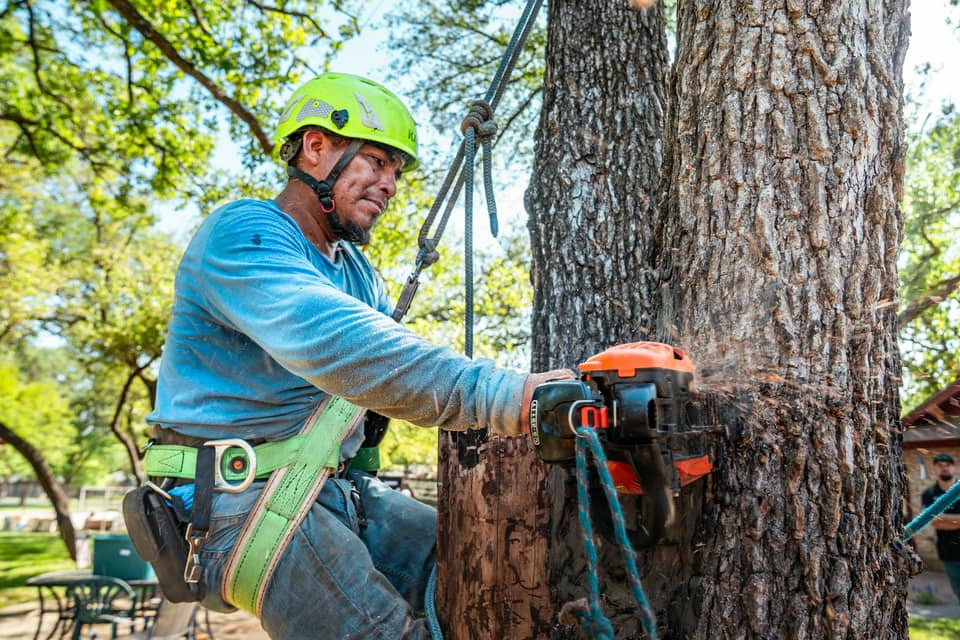
Very few trees in a Lubbock back yard are simply felled. Lots are narrow, there is usually a fence, a garage or the alley power line in the way, and the only open ground is often the lawn you would rather not have a trunk land on. So most mature trees come down in sections.
Climbing and rigging
A climber goes up on ropes, removes the smaller limbs first, then takes the big limbs and the trunk in pieces, each one tied off and lowered on a rope through a pulley rather than dropped. This is slower and more skilled work than felling, which is most of why a tree over a house costs several times what the same tree in an open field would.
Bucket trucks and alley access
Many Lubbock homes back onto an alley, and that matters. A bucket truck or a chipper that can get down the alley saves hours of dragging brush through the house gate. If your alley is narrow, unpaved or blocked by the city waste containers, say so when you call, because it changes what equipment can reach the tree.
Cranes
For a large dead tree leaning over a house, where nobody should climb a brittle trunk, a crane may be the safe option. It raises the price sharply but it can turn a two-day rigging job into a few hours, and on some jobs it is the only responsible way to do it.
What should be in the estimate
Ask for it in writing, and make sure it says what happens to everything that comes down. Tree jobs go wrong on the parts nobody wrote down.
- Whether the price includes hauling away all wood and brush, or leaves logs on site
- Whether stump grinding is included, and if so how deep and whether the grindings are removed
- Who is responsible for fence panels, sprinkler heads and lawn damage from equipment
- Proof of general liability insurance, and ideally workers' compensation or an equivalent policy for the crew
- What happens if the job uncovers something unexpected, such as rot inside the trunk or a buried line
- When payment is due. Nothing up front beyond a modest deposit is normal for residential work
What Texas does and does not require
Texas has no state licence for tree trimming or removal. Anyone with a chainsaw and a truck can advertise, which is why insurance is the thing to check rather than a licence number. ISA arborist certification is a real credential but it is voluntary, so its absence is not a red flag on its own and its presence does not replace insurance.
Two things do carry legal weight. Spraying or injecting a tree with any pesticide for hire requires a Texas Department of Agriculture applicator licence, so a company offering to treat a tree should be able to show one. And anything within ten feet of a high-voltage line is work for a utility-authorized crew only, which Lubbock Power and Light points out in its own safety guidance.
Trees in the parkway, and trees on the line
The strip between the sidewalk and the street is not entirely yours to decide on. Lubbock's code gives the Parks and Recreation director authority over trees in parkways and on city land, so check with the city before taking down a tree in that strip. On your own lot behind the sidewalk, we have not found a city permit requirement for removing a residential tree.
If the tree touches a power line, the first call is to the electric utility, not a tree company. In most of the city that is Lubbock Power and Light; on the edges and in the surrounding towns it may be South Plains Electric Cooperative or Xcel Energy. They will make the line safe, and in some cases do the clearance work themselves.
When to book
Tree removal is not seasonal the way some trades are. Searches for it in Lubbock run all year, dip in December and January, and peak in July when summer storms bring limbs down and drought makes dead trees obvious. A dead tree is easiest to judge in summer, when it stands bare next to trees in full leaf, and many companies have more room on the calendar in late fall and winter.
If the tree is dead or split, the spring wind season is the deadline that matters. A dead tree that stands through March and April in Lubbock is a tree that has been lucky. Get the estimate before then, not after.
Have a tree you are not sure about? Call for a free estimate. A local tree company will look at it, tell you whether it needs to come down or can be pruned and kept, and put the price in writing.
| Tree | Common in | Usual failure | Typical outcome |
|---|---|---|---|
| Siberian elm | Older central, north and east Lubbock; fence lines everywhere | Split forks, brittle limbs in wind and ice | Removal when large and over a structure; heavy pruning if young |
| Cottonwood | Older large lots, near playa lakes and drainage | Heavy limb drop, hollow trunks with age | Removal of declining trees; pruning buys time on healthy ones |
| Ash | Mid-century neighbourhoods | Dieback from the top, decay at old pruning wounds | Often removed once more than a third of the crown is dead |
| Afghan or Austrian pine | Windbreaks, screens along back fences | Browns out after drought and rarely recovers | Removal; a dead pine gets more brittle the longer it stands |
| Bradford pear | Front yards in 1990s and 2000s subdivisions | Splits apart at the main forks as it matures | Removal; usually one of the cheaper jobs |
Where we work in Lubbock
- OvertonCentral, north of Texas Techplatted in 1907 by a developer who promoted street trees from the start, so some of the oldest neighbourhood trees in the city stand here, many of them leaning over alleys, brick streets and older overhead service lines
- Tech TerraceCentral, south of Texas Tech1920s to 1950s houses under a mature canopy around Wagner Park; big trees on small lots, so most removals here are climbed and lowered in pieces rather than felled
- Heart of LubbockCentralmid-century houses on tree-lined streets, old enough that many of the big trees are species the city no longer allows as new street plantings
- LakeridgeSouthwestbuilt mostly in the 1980s and 1990s around the LakeRidge Country Club, so the trees are now 30 to 40 years old and reaching the size where pruning and clearance from roofs becomes a regular job
- Vintage TownshipFar south, Quaker to Utica below 114tha 320-acre subdivision begun in 2007 with narrow tree-lined streets; young trees whose structural pruning now decides how they handle wind in twenty years
- North and East Lubbock79403 and 79415older lots with more open ground, and plenty of self-seeded Siberian elm along fences and alleys, which is where a lot of fence-line removal work comes from
ZIP codes served79401 · 79403 · 79404 · 79407 · 79410 · 79411 · 79412 · 79413 · 79414 · 79415 · 79416 · 79423 · 79424
Common questions
What does tree removal cost in Lubbock?
Local companies generally quote somewhere around $250 to $700 for a small tree with clear access, $700 to $1,800 for a medium one, and $1,800 to $4,000 or more for a mature tree that has to be climbed and lowered over a house, fence or line. Crane jobs and emergency call-outs sit above that. We do not set prices; the company that quotes you does. The cost guide goes through what moves the number.
Is stump grinding included?
Often not. Many estimates cut the trunk close to the ground and leave the stump, with grinding as a separate line or a separate visit. Ask, and if it is included ask how deep the grinder goes and whether the chips are hauled off or left in the hole.
Do I need a permit to take a tree down?
For a tree on private residential property behind the sidewalk we have not found a Lubbock city permit requirement. Trees in the parkway strip fall under the Parks and Recreation director, and some newer subdivisions have HOA rules about removing trees. Check both before anyone starts.
The tree is dead. Is it urgent?
It depends what it would hit. A dead tree in open ground can wait for a convenient date. A dead tree over a roof, a driveway or a line should come down before the next spring wind season. Dead wood dries out and gets brittle, which makes it more dangerous to climb and more likely to fail.
Can a tree be removed without going through my house or yard?
Often, if there is alley access. A lot of Lubbock lots back onto an alley, and a truck and chipper working from there avoids dragging brush through the gate. Tell the company about the alley, its width, and whether anything blocks it, when you ask for the estimate.
Will my homeowner's insurance pay for removal?
Usually only when a tree has fallen on something covered, such as the house or a fence, and even then many policies cap tree removal at a few hundred dollars per tree. A dead tree that is still standing is normally treated as maintenance. Your policy wording decides it; ask your insurer before assuming either way.
My neighbour's tree hangs over my yard. Can I have it removed?
You can generally have branches that cross onto your side trimmed back to the property line at your own cost, but not the tree itself taken down, and not trimmed in a way that kills it. Talk to the neighbour first. If the tree is dead and threatening your house, putting that in writing to them is the sensible first step.
Who handles a tree that is touching a power line?
The electric utility first. In most of Lubbock that is Lubbock Power and Light. Stay away from the tree and the line, and call 911 only if a line is down and someone is in danger. Work within ten feet of a high-voltage line is reserved for crews the utility has authorized.
How long does a removal take?
A small tree in open ground can be an hour or two. A large tree over a house, taken down in sections and cleaned up properly, is commonly a full day for a small crew, and longer if the brush has to be carried out by hand rather than chipped from the alley.
More tree work in Lubbock
- Tree Service in Lubbock: Assessments
- Tree Trimming and Pruning in Lubbock
- Storm-Damaged Tree Cleanup in Lubbock
- Stump Grinding in Lubbock, TX
Also serving
Tree Removal is available beyond Lubbock, across Wolfforth , Slaton , Levelland and Brownfield .
Get an estimate for tree removal
Tell us about the tree and a local tree company will come and look at it, usually within a few days, sooner for a limb on a roof. Answered Mon–Sat, 7am–6pm · storm calls after hours get a call back first thing Or call (806) 515-3071. If a limb is on a roof or a line, call rather than typing.